

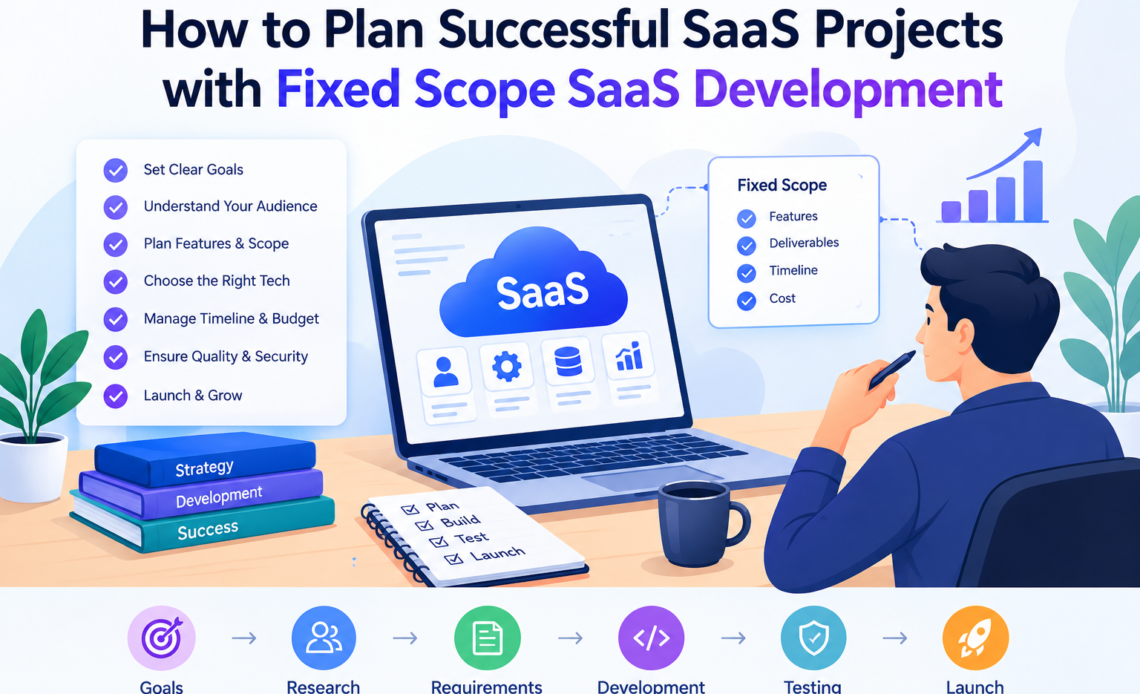
Software as a Service (SaaS) has become a popular business model for delivering digital products, automating workflows, and providing subscription-based services. Businesses across industries are investing in SaaS applications to improve customer experiences, streamline operations, and create new revenue opportunities. However, building a successful SaaS product requires more than an innovative idea. It involves careful planning, clear requirements, realistic budgeting, effective communication, and a well-organized development process.
Fixed Scope SaaS Development offers a structured approach to planning and delivering software projects by defining the required features, project deliverables, timelines, and costs before development begins. This approach helps businesses establish clear expectations and manage development activities around specific objectives.
For startups, entrepreneurs, and established organizations, planning a SaaS project with a clearly defined scope can reduce misunderstandings and improve resource allocation. It also helps development teams focus on essential features instead of constantly changing priorities. By following a systematic planning process, businesses can create a strong foundation for a reliable, scalable, and user-friendly SaaS product.
What is Fixed Scope SaaS Development?
Fixed Scope SaaS Development is a software development model in which the project’s requirements, features, deliverables, and agreed costs are defined before the main development work starts. The business and development team collaborate to determine what the software should accomplish and how the agreed functionality will be delivered.
This approach is especially useful when a company has a reasonably clear product vision and can identify its essential requirements before development begins.
Key Components of a Fixed-Scope SaaS Project
A well-planned project typically includes the following components:
- Project objectives: The business goals the SaaS application is expected to achieve.
- Functional requirements: The features and workflows the application must support.
- Technical specifications: The technologies, integrations, infrastructure, and security requirements needed for implementation.
- Project timeline: Development milestones, review stages, testing periods, and expected delivery dates.
- Budget and deliverables: The agreed development cost and the specific work included in the project.
- Acceptance criteria: The conditions used to determine whether the completed software meets the documented requirements.
When these elements are clearly defined, businesses and development teams can work toward a common goal with fewer uncertainties.
1. Define Clear Business Goals Before Development
The first step in planning a successful SaaS project is understanding why the product is being developed. Businesses should identify the problem they want to solve, the audience they intend to serve, and the value the application will provide.
Without clear business goals, development teams may spend time building features that do not directly support the product’s purpose.
Identify the Problem Your SaaS Product Solves
Start by examining the challenges faced by your target customers. These challenges might include inefficient business processes, manual data entry, poor communication, limited reporting capabilities, or difficulties managing subscriptions.
For example, a company developing a project management SaaS platform might aim to help remote teams organize tasks, track deadlines, and collaborate more efficiently. These goals provide direction for determining the product’s initial functionality.
Establish Measurable Objectives
Business objectives should be specific enough to guide development decisions. Depending on the product, these objectives might include reducing administrative work, improving customer retention, simplifying internal workflows, or enabling customers to manage information from one centralized platform.
Clear objectives help businesses evaluate whether the proposed features are necessary and whether the final product supports the intended business outcomes.
2. Conduct Market Research and Understand Your Audience
Market research helps businesses determine whether their SaaS idea addresses a genuine need. Even a technically advanced application may struggle if it does not offer meaningful value to its intended users.
Before finalizing the project scope, businesses should research their target market, customer expectations, existing alternatives, and competitors.
Identify Your Ideal Customers
Create a clear picture of the people or organizations that will use the application. Consider their industry, business size, common challenges, technical knowledge, and purchasing behavior.
For instance, a SaaS accounting platform designed for small businesses may require simple dashboards and straightforward reporting. An enterprise accounting solution may need advanced permissions, complex integrations, and more detailed financial controls.
Understanding these differences helps determine which features belong in the initial scope.
Analyze Competitors and Market Gaps
Review competing SaaS products to understand their strengths, limitations, pricing structures, and user experiences. Customer reviews, product demonstrations, and industry discussions can reveal problems that existing solutions do not adequately address.
Use these findings to establish a clear product direction instead of simply copying competitor features.
3. Gather and Document Detailed Requirements
Requirement gathering is one of the most important stages of Fixed Scope SaaS Development. The accuracy of the initial requirements directly influences project estimates, development priorities, testing plans, and delivery expectations.
Businesses should involve relevant stakeholders before approving the project scope.
Define Functional Requirements
Functional requirements explain what the application must do. Depending on the product, these requirements may include:
- User registration and authentication
- Subscription and payment management
- Role-based access permissions
- Administrative dashboards
- Notifications and communication tools
- Reports and analytics
- Third-party API integrations
Not every SaaS application needs all these features. The final list should reflect the product’s purpose and the needs of its intended users.
Document Non-Functional Requirements
Non-functional requirements describe how the application should perform. These may include response times, availability expectations, security controls, accessibility, data protection, and scalability considerations.
For example, a SaaS platform handling sensitive business information may require strong authentication, encryption, access controls, and appropriate data backup procedures.
Documenting these requirements early helps the development team plan a suitable technical architecture and avoid important omissions.
4. Prioritize Features and Establish the Project Scope
A common mistake in SaaS development is attempting to build too many features in the first release. Excessive functionality can increase development costs, complicate testing, and delay the launch.
Fixed Scope SaaS Development encourages businesses to identify essential features and establish clear boundaries for the initial project.
Separate Essential Features From Future Enhancements
Organize potential features into categories based on their importance to the product’s core purpose.
For example, a SaaS customer relationship management platform might need contact management, lead tracking, and basic reporting for its first release. Advanced predictive analytics, extensive automation, and specialized integrations could be considered for future versions if they are not essential initially.
This prioritization helps keep the initial scope manageable without losing sight of long-term product goals.
Create a Detailed Scope Document
The scope document should explain which features are included, what each feature is expected to accomplish, and which deliverables the development team must provide.
It should also clarify exclusions, dependencies, assumptions, and the procedure for approving additional requirements.
A clear scope document reduces the risk of misunderstandings and provides a reference point throughout the project.
5. Choose the Right Technology Stack and Architecture
Technology decisions affect the application’s performance, maintainability, security, and ability to support future growth. Businesses should select technologies based on their product requirements rather than choosing tools simply because they are popular.
Evaluate Technologies Based on Project Needs
The technology stack may include frontend frameworks, backend technologies, databases, cloud infrastructure, and external services.
The right combination depends on factors such as expected traffic, application complexity, development team expertise, integration requirements, and available budget.
For example, a SaaS analytics platform processing large datasets may have different architectural needs from a simple appointment scheduling application.
Plan for Scalability and Maintainability
Even if the first release serves a relatively small audience, the architecture should account for realistic growth expectations. Consider database design, application monitoring, backup strategies, access management, and deployment processes.
Scalability does not always require a complex distributed architecture from the beginning. The objective is to choose a practical design that meets current requirements while allowing sensible improvements as demand increases.
6. Establish a Realistic Budget and Development Timeline
A successful SaaS project needs a realistic financial and scheduling plan. Underestimating the work involved can create pressure on developers, affect product quality, and disrupt launch plans.
A fixed-scope model helps businesses estimate costs based on the agreed deliverables before development begins.
Identify the Main Cost Factors
The project budget should account for the work required to complete the agreed scope. Depending on the project, this may include:
- Business analysis and requirements planning
- UI/UX design
- Frontend and backend development
- Database implementation
- API and third-party integrations
- Quality assurance and testing
- Deployment preparation
Hosting, subscriptions to third-party services, ongoing maintenance, and post-launch support should also be considered when estimating the total cost of ownership. These expenses may be separate from the initial development agreement.
Break the Timeline Into Milestones
Divide the project into manageable stages, such as discovery, design, development, integration, testing, and deployment.
Assign deliverables and review points to each milestone. Account for stakeholder approvals, external dependencies, and sufficient testing time.
A realistic schedule is more valuable than an overly optimistic deadline that leaves little room for quality checks or necessary adjustments.
7. Create a User-Friendly Design
The user experience plays a significant role in SaaS adoption and customer retention. Even an application with powerful functionality may struggle if users find it confusing or difficult to navigate.
Design planning should begin before full-scale implementation.
Develop User Journeys and Wireframes
Map out how users will complete their most important tasks. These tasks might include creating an account, configuring a workspace, inviting team members, managing subscriptions, or generating reports.
Wireframes help visualize the application’s structure and navigation before developers invest time in implementing the interface.
Focus on Usability and Accessibility
Use consistent layouts, clear navigation, readable text, helpful error messages, and understandable workflows. Consider mobile responsiveness and accessibility requirements relevant to the target audience.
Reviewing design prototypes with representative users can reveal usability problems early, when changes are generally easier to accommodate within the planning process.
8. Define Quality Assurance and Security Requirements
Testing and security should be part of the original project plan rather than activities left until the final days before launch.
SaaS applications often handle user accounts, business information, payments, and other sensitive data. Poor security or unreliable functionality can damage customer trust.
Plan a Structured Testing Process
Quality assurance should verify that the application meets the documented requirements. Testing activities may include:
- Functional testing of essential features
- Integration testing for connected services
- Compatibility testing across supported devices and browsers
- Performance testing under expected workloads
- Security testing and vulnerability assessments
- User acceptance testing against agreed criteria
The scope agreement should clarify the testing activities included in the project and how defects will be evaluated and addressed.
Include Security From the Beginning
Plan for appropriate authentication, authorization, secure data handling, logging, backup procedures, and dependency management. SaaS businesses should also evaluate applicable privacy obligations and industry-specific compliance requirements.
Security responsibilities do not end at launch. Ongoing monitoring, updates, vulnerability management, and incident response planning remain important throughout the product’s lifecycle.
9. Establish Communication and Change Management Processes
Even well-planned projects require regular communication. Business stakeholders may need clarification, technical teams may discover unexpected dependencies, and priorities may change as new information becomes available.
A clear communication process helps address these situations without losing control of the project.
Schedule Regular Progress Reviews
Establish a routine for reviewing completed deliverables, outstanding tasks, risks, and upcoming milestones. Project updates should provide enough detail for stakeholders to understand progress and make timely decisions.
Designated points of contact can help avoid conflicting instructions and unnecessary delays caused by unclear approvals.
Manage Scope Changes Carefully
A fixed scope does not mean that changes are impossible. It means that changes should be reviewed before being added to the agreed project.
When a stakeholder requests a new feature, the team should assess its impact on cost, timeline, technical complexity, and existing functionality. The change should then be approved or deferred through the agreed process.
This allows the project to adapt when necessary while preserving a clear record of commitments and deliverables.
10. Prepare for Launch and Post-Launch Growth
Completing development is only one part of delivering a successful SaaS product. Businesses must also prepare for deployment, customer onboarding, operational monitoring, and future improvements.
These activities should be considered during the planning stage so responsibilities and costs are clear.
Create a Launch Readiness Checklist
Before release, verify that essential functionality has passed the agreed tests, production infrastructure is configured, backups are available, and monitoring tools are ready.
Documentation, onboarding materials, customer support procedures, and payment configuration should also be prepared where applicable.
A staged rollout may be appropriate when the product requires additional validation before becoming available to a wider audience.
Plan for Continuous Improvement
After launch, businesses should review user feedback, product usage, customer support requests, and performance data. These insights can inform future feature priorities and help identify opportunities to improve the customer experience.
A fixed-scope initial release can provide a controlled starting point, while subsequent development cycles introduce enhancements based on actual business needs.
How App Scoop Can Support SaaS Development Planning
Choosing an experienced development partner can help businesses translate their ideas into clear technical requirements and practical implementation plans.
App Scoop is an AI-native software development company offering mobile app development, web app development, AI automation, LLM integration, API integration, and intelligent data processing services.
For organizations planning a SaaS product, App Scoop can be considered for discussions about product requirements, feature prioritization, technical architecture, integrations, and development planning.
A productive engagement should begin with an understanding of the business objectives, target users, required functionality, budget expectations, and delivery constraints. These details help establish a suitable project scope and identify technical dependencies before development begins.
Businesses should also confirm the agreed deliverables, testing responsibilities, change management process, deployment arrangements, and post-launch support terms with their development partner.
By aligning business goals with a clearly documented development plan, companies can make more informed decisions and establish a stronger foundation for their SaaS products.
Conclusion
Planning a successful SaaS project requires a clear understanding of customer needs, business objectives, technical requirements, and available resources. Fixed Scope SaaS Development provides a structured framework for bringing these elements together before development begins.
By defining measurable goals, conducting market research, documenting requirements, prioritizing features, selecting appropriate technologies, and establishing realistic budgets, businesses can reduce uncertainty and improve project coordination.
Effective planning should also include user experience, security, quality assurance, communication, and post-launch operations. A well-defined change management process ensures that additional requirements are evaluated carefully instead of being introduced without considering their impact.
For startups and established businesses alike, a carefully planned fixed-scope project can provide greater visibility into deliverables, costs, and timelines. With the right development partner and a realistic implementation strategy, businesses can build useful SaaS applications that address customer needs and support long-term growth.
